
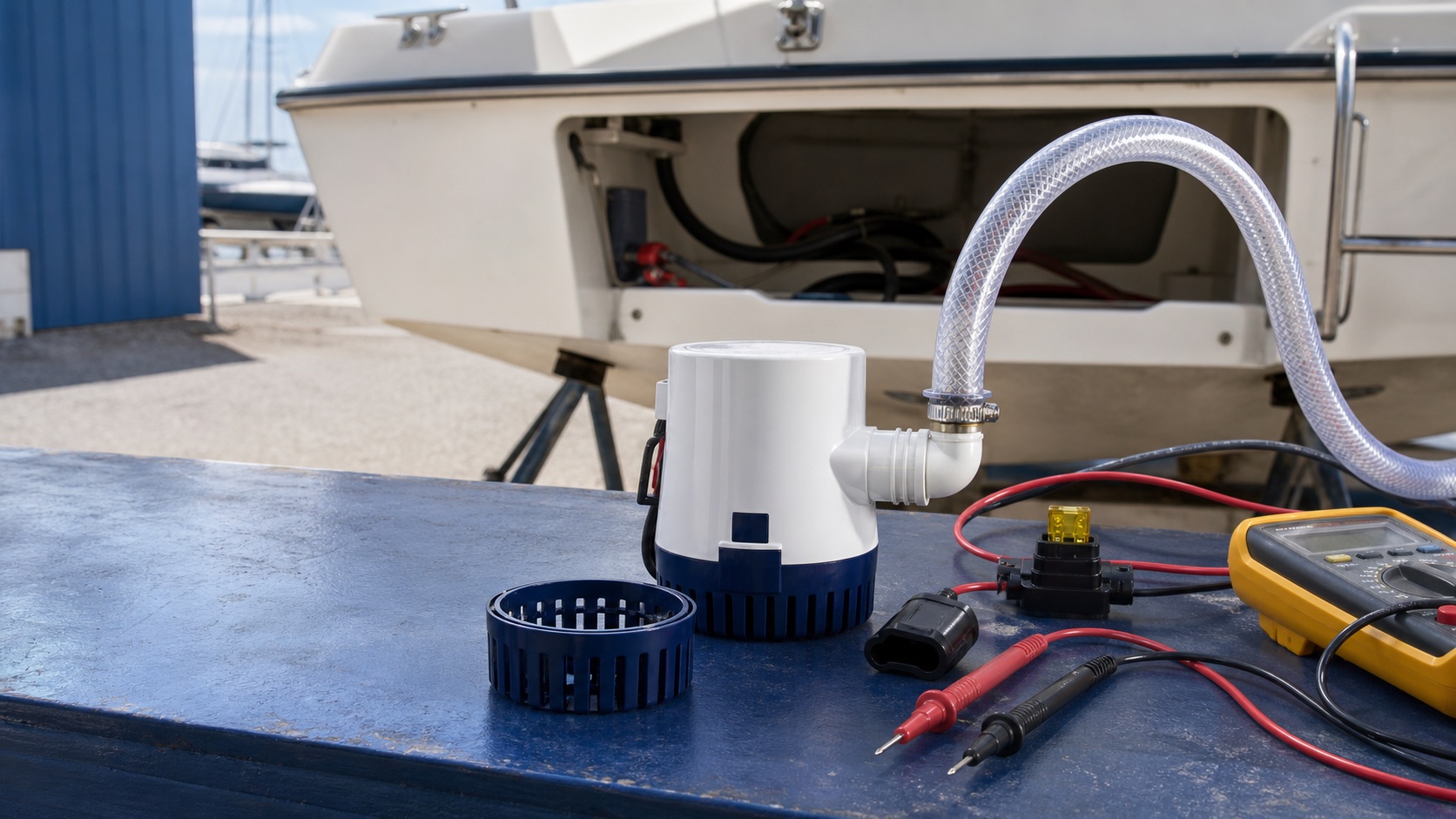
Quick answer: If a submerged centrifugal bilge pump runs but moves no water, protect the boat first, then check in this order: submerged intake and debris, a pinched or obstructed discharge, hose dips that can trap air, and voltage measured at the pump while it is running. Do not assume a spinning motor proves adequate flow or voltage. Record the exact pump model, system voltage, specified fuse, hose diameter, battery reading, and loaded pump-terminal reading before replacing anything.
First identify which kind of pump you have
The troubleshooting path depends on pump design. Rule’s standard submersible pumps and Rule-Mate automatic pumps are centrifugal designs. Their impellers must be in contact with water; they are not self-priming. Xylem’s air-lock demonstration shows how a pump can audibly run while an air pocket remains at the impeller because a sag in the discharge hose traps water downstream.
A Rule Dry Bilge Pump is different. Xylem describes it as a self-priming, non-submersible diaphragm pump that draws through a remote pickup hose. It is designed to remove residual water to about 1/8 inch (3 mm). Do not apply a submersible pump’s “keep the impeller submerged” test to that system, and do not apply dry-bilge priming expectations to a standard centrifugal pump.
- Submersible centrifugal: pump body sits in the bilge; the inlet/strainer and impeller need water around them.
- Automatic submersible: still centrifugal, but water detection or a timed check controls when it runs. “Automatic” does not mean self-priming.
- Self-priming dry-bilge pump: non-submersible diaphragm unit with a pickup hose; use its own installation and service instructions.
Symptom-to-diagnostic table
Start with observations, not replacement parts. A restriction, trapped air, and inadequate loaded voltage can all sound like “the motor runs,” but they leave different clues.
| What you observe | Check first | What the result suggests | Record before changing parts |
|---|---|---|---|
| Motor runs; no water reaches the outlet | Confirm the centrifugal pump inlet is submerged, the strainer is clear, and the discharge hose rises continuously without a valley | A dry impeller cavity or trapped air is more likely than an electrical open circuit | Pump type, water level, hose route, vertical lift, model number |
| Some flow, but much less than expected | Look for debris, a flattened hose, tight bends, reduced-diameter fittings, a restricted check valve, and excessive hose length or lift | Discharge resistance can reduce actual flow even when the pump spins normally | Hose inside diameter, run length, bends, fittings, thru-hull size |
| Flow starts after the hose is lifted or rerouted | Inspect the former low spot for retained water | The hose valley was consistent with Xylem’s demonstrated air-lock mechanism | Before/after hose route and whether the line now rises continuously |
| Pump sounds slow, weak, or changes tone under load | Measure voltage at the battery and at the pump terminals while the pump is commanded on | A lower loaded reading at the pump points to loss in wiring, connections, the fuse holder, switching, or ground | Both loaded voltage readings, system voltage, wire length/gauge, fuse size |
| Rule-Mate stops, then checks about every 2.5 minutes | With power isolated, inspect for debris, a fouled sensor area, or an air-bound condition | The current Rule-Mate manual describes this as a protective backup mode after the motor runs without moving water | Exact Rule-Mate model, condition of sensor/intake, water level, cycle timing |
| Non-submersible dry-bilge system does not draw | Stop using the centrifugal checklist and follow the diaphragm pump’s own manual for pickup, plumbing, and electrical tests | Its self-priming architecture is different; submerging the pump body is not the remedy | Dry-bilge model, pickup route, 12 V supply, specified 10 A fuse |
A practical diagnostic order
- Control the water source. A bilge pump is not damage-control equipment for hull flooding. If water is rising, identify and stop the ingress when safe, use backup dewatering equipment, and call for assistance.
- Read the label. Photograph the model number, rated voltage, fuse requirement, and outlet size. Do not infer those fields from color, pump shape, or headline GPH alone.
- Isolate power before touching the pump or hose. Clear visible debris from the intake/strainer and inspect the impeller area only as the model manual permits. Keep wire connections above the highest water level.
- Trace the complete discharge. Look for a kink, collapsed hose, clogged thru-hull, tight bend, smaller fitting, obstructed check valve, or a long run. Xylem says longer piping, more bends, rough interior surfaces, and reductions in cross-sectional area reduce flow.
- Remove hose valleys. For a submersible centrifugal pump, route the discharge continuously upward. Xylem’s demonstration shows that residual water in a sag can hold an air pocket at the impeller and prevent pumping.
- Test loaded voltage only if access is safe. A static battery reading does not show the whole circuit under pump load. If you are not trained to test a marine DC circuit—or the space may contain fuel vapor—stop and use a qualified marine electrical technician.
- Retest with observed discharge. Do not leave an automatic pump unattended merely because it makes noise. Confirm that water actually exits and that the pump stops or returns to its normal automatic mode as designed.
Air lock versus restriction
Air lock: the pump cannot get water onto the impeller
In Xylem’s Rule video, a low point in the discharge retains water after the pump stops. The retained water traps an air pocket between the hose and the centrifugal pump’s impeller cavity. When bilge water rises and the pump restarts, the impeller spins in air instead of moving water. The manufacturer’s stated takeaway is simple: the discharge line should run continuously upward without dips and sags.
Do not improvise by drilling a vent hole into a pump or hose unless the exact model’s current instructions explicitly call for one. A feature used on one design is not a universal repair and can create leakage or reduce performance.
Restriction: the pump moves water against too much resistance
A restriction may still allow a weak stream. Inspect the entire path from strainer to thru-hull. The Rule-Mate manual specifically identifies longer runs, bend count/radius, rough hose interiors, and reduced cross-sectional area—including some valves and thru-hulls—as flow reducers. Use smooth-bore flexible hose of the model-specified diameter and secure it as the manual directs.
A check valve is not a substitute for anti-siphon protection. The Rule-Mate manual says a vented loop or another approved means is required in the described below-waterline configuration and says a check valve must not be used for that purpose. It allows a check valve only when necessary to prevent an automatic pump from cycling because discharge water flows back. Plumbing and thru-hull decisions should follow the boat and pump instructions.
How to make the voltage check useful
Voltage must be matched to the exact model. The current Rule-Mate manual specifies a minimum of 10.5 V for its 12 V pumps and 21 V for its 24 V pumps. Those values are not permission to run every marine pump at the same threshold; use the label and current manual for the installed model.
When safe and within your skills, record two readings while the pump is actually running: voltage directly across the battery terminals and voltage across the pump’s positive and negative supply at the pump. The difference is the loss through the complete positive-and-negative circuit under load. A healthy-looking battery reading alongside a substantially lower pump reading directs attention to run length/wire gauge, corroded or wet connections, switching, the fuse holder, and the ground path—not automatically to the pump motor.
Do not bypass protection or install a larger fuse to “see if it works.” The fuse protects the circuit from a short; it is not a tuning device. Xylem also requires waterproofed connections above the highest water level and provides a wire-size table based on total positive-to-pump-to-ground length in the Rule-Mate manual.
Exact model, voltage, fuse, and hose fields
The tables below are identification aids from Xylem’s current Rule quick-reference guide. Confirm the physical label and current manual before service. Similar capacities can use different controls, fuses, or plumbing.
| Rule-Mate level-sense model | System | Specified fuse | Current at rated test points | Hose diameter |
|---|---|---|---|---|
| RM500B (500 GPH) | 12 VDC | 4 A | 1.8 A at 12 V; 2.4 A at 13.6 V | 3/4 in. (19 mm) |
| RM800B (800 GPH) | 12 VDC | 5 A | 3.0 A at 12 V; 3.7 A at 13.6 V | 3/4 in. (19 mm) |
| RM1100B (1100 GPH) | 12 VDC | 7.5 A | 3.8 A at 12 V; 4.8 A at 13.6 V | 1 in. (25 mm) or 1-1/8 in. (29 mm) |
Parts4Marine also has current catalog pages for these non-automatic Rule pumps. They require a compatible float or panel switch; they are not Rule-Mate level-sense models.
| Related catalog product | System | Specified fuse | Hose diameter | Control distinction |
|---|---|---|---|---|
| Rule 24DA, 360 GPH | 12 VDC | 4 A | 3/4 in. (19 mm) | Non-automatic; match a compatible switch |
| Rule 25DA, 500 GPH | 12 VDC | 4 A | 3/4 in. (19 mm) | Non-automatic; match a compatible switch |
| Rule 20DA, 800 GPH | 12 VDC | 7.5 A | 3/4 in. (19 mm) | Non-automatic; match a compatible switch |
| Rule 27DA, 1100 GPH | 12 VDC | 7.5 A | 1 in. (25 mm) or 1-1/8 in. (29 mm) | Non-automatic; match a compatible switch |
Stop troubleshooting and protect people and the boat if:
- bilge water is rising, the source is unknown, or flooding may come from hull damage;
- you smell fuel, see fuel or oil in the bilge, or cannot confirm the space is safe for electrical work;
- wiring, a terminal, switch, or fuse holder is hot, melted, sparking, wet, or visibly corroded;
- the discharge thru-hull, seacock, vented loop, or anti-siphon arrangement is uncertain;
- the installed fuse is larger than the exact model specification, repeatedly opens, or has been bypassed;
- the pump is not ignition protected where the installation requires ignition-protected equipment; or
- you cannot safely reach the pump while keeping the boat stable and electrical connections dry.
Disconnect power before servicing the pump or plumbing. Use backup dewatering and qualified marine help when water ingress, fuel vapor, damaged wiring, or below-waterline plumbing is involved.
Bilge pump troubleshooting FAQ
Can a centrifugal bilge pump run without moving water?
Yes. Xylem’s Rule demonstration shows a centrifugal pump running while trapped air remains at the impeller. Because this pump type is not self-priming, motor noise alone does not prove water is moving.
Should I install a bigger pump when flow is weak?
Not before diagnosing the system. A blocked intake, undersized hose, extra bends, long discharge run, restricted fitting, excessive lift, trapped air, or low loaded voltage can limit a replacement too. Match capacity only after the plumbing and electrical path are verified.
Why does my Rule-Mate switch to a 2.5-minute cycle?
The current manual says Rule-Mate programming can enter a backup checking mode when it detects the motor running without doing enough work, including an air-bound pump or debris/fouling. Isolate power, correct the cause, and follow the model instructions; normal level-sensing operation should return after the condition is removed.
Is a dry-bilge pump just a standard pump mounted higher?
No. Xylem’s current dry-bilge explainer describes a non-submersible, self-priming diaphragm pump with a remote pickup. Standard and Rule-Mate submersible pumps are centrifugal and require water at the impeller.
What information should I send when asking for help?
Send a readable model-label photo, 12/24 V system voltage, installed fuse rating, hose inside diameter and route, vertical lift, battery voltage under pump load, voltage at the pump under the same load, and clear photos of the intake, wiring, and thru-hull path.
Match the system before replacing the pump
Browse Pumps & Plumbing, then compare the exact model, voltage, fuse, outlet, switch type, and hose path. Product availability can change; a catalog page is not a substitute for the installed pump label or manufacturer manual.
For a fitment check, email sales@parts4marine.com with the model-label photo and the diagnostic fields listed above.
Primary Xylem / Rule sources
- Xylem / Rule: Explaining an Airlock in a Bilge Hose — manufacturer demonstration of a hose valley trapping air at a non-self-priming centrifugal pump.
- Xylem / Rule: Rule-Mate 500–1100 Instruction Manual — current safety, wiring, fuse, minimum-voltage, plumbing, backup-mode, and performance guidance.
- Xylem / Rule: Rule Quick Reference Guide, Rev E (November 2025) — current model, voltage, fuse, current, strainer, hose, and control tables for standard, Rule-Mate, and automatic pumps.
- Xylem / Rule: The Rule Dry Bilge Pump in Action — manufacturer explanation of the self-priming, non-submersible diaphragm design and its 12 V / 10 A specification.